
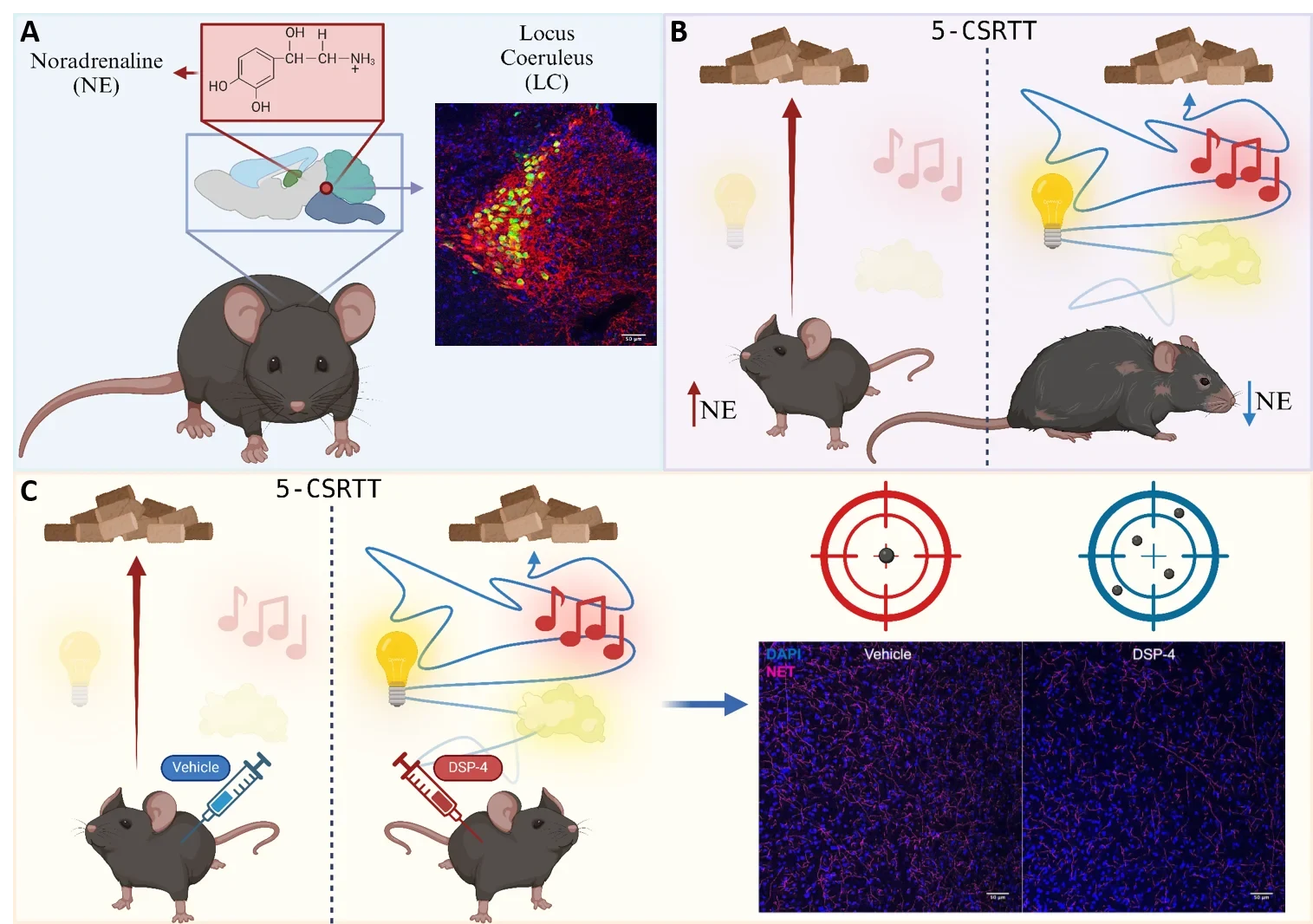
The locus coeruleus (LC) (A) is an area that has been shown to be sensitive to ageing in humans, but whether this also holds true in the mouse model was unknown.
In our present study, we asked whether the age-related reduction in the number of noradrenergic neurons in mice leads to a change in attention that is similar to that observed in old humans.
We found that the number of noradrenergic neurons also decreased with age in our mouse model, and that old animals showed a similar impairment in attention as older humans (B).
To prove that the LC was directly responsible for this impaired attention, we recapitulated the aged phenotype in young animals by treating them with DSP-4, a neurotoxin selective for noradrenergic neurons. We were able to confirm that even a mild reduction in noradrenergic signalling was responsible for the impaired attention and greater distractibility when performing tasks requiring attention (C).